How Does Wordle Work? Rules Explained for Beginners
Wordle in plain terms: six guesses, one five-letter word, and what green, yellow and grey actually mean. Plus the duplicate-letter rule.
Wordle looks simple. One word. Six tries. Three colors.
But if you're new, those colored tiles can feel confusing fast. Why did that letter turn yellow? Why is one E green and the other gray?
This guide explains how does wordle work in plain terms. All the wordle rules, what each color means, and the one rule that trips up almost every beginner.
No strategy talk yet. Just how to play wordle properly, start to finish.
What Is Wordle?
Wordle is a free daily word game. One hidden five-letter word. Six tries to find it.
The best part? Everyone in the world gets the same word each day. Your friend in another country is solving the exact same puzzle you are.
No timer. No app to download. No signup. You just open the page and play.
Will Shortz, the New York Times crossword editor, called it "a game of logic involving words". That sums up what is wordle pretty well. You're not just guessing words. You're using clues to narrow things down.
And once a day is it. One puzzle, then tomorrow's. That daily limit is a big part of why people stick with it. The wordle rules never change, so once you learn them, you're set.
The Basic Rules
The whole game runs on a handful of wordle rules. Here they are.
- You get six guesses to find the hidden word
- Every guess must be a real five-letter word, not random letters
- The answer is always exactly five letters
- One new puzzle per day, same word for everyone
- No time limit, take as long as you want
- Free to play, no account needed
That's it. That's how to play wordle. Six tries, five letters, one word a day.
The "real word" rule catches beginners out. You can't type QQQQQ to test letters. The game rejects it, so you only get to guess from actual 5 letter words.
How the Colors Work (Green, Yellow, Gray)
This is the heart of the game. After each guess, every tile changes color. Those colors are your clues.
Green means the letter is correct and in the right spot. Lock it in. Don't move it.
Yellow means the letter is in the word, but you placed it wrong. Keep it, try it somewhere else.
Gray means the letter isn't in the word at all. Drop it.
Here's a quick example. Say the answer is SHINE and you guess STONE.
S turns green. It's the first letter in both. T turns gray, not in the word. O turns gray too. N turns yellow, it's in SHINE but sits in a different spot. E turns green, last letter in both.
So after one guess you know: starts with S, ends with E, has an N somewhere in the middle, and no T or O. That's a lot from a single try.
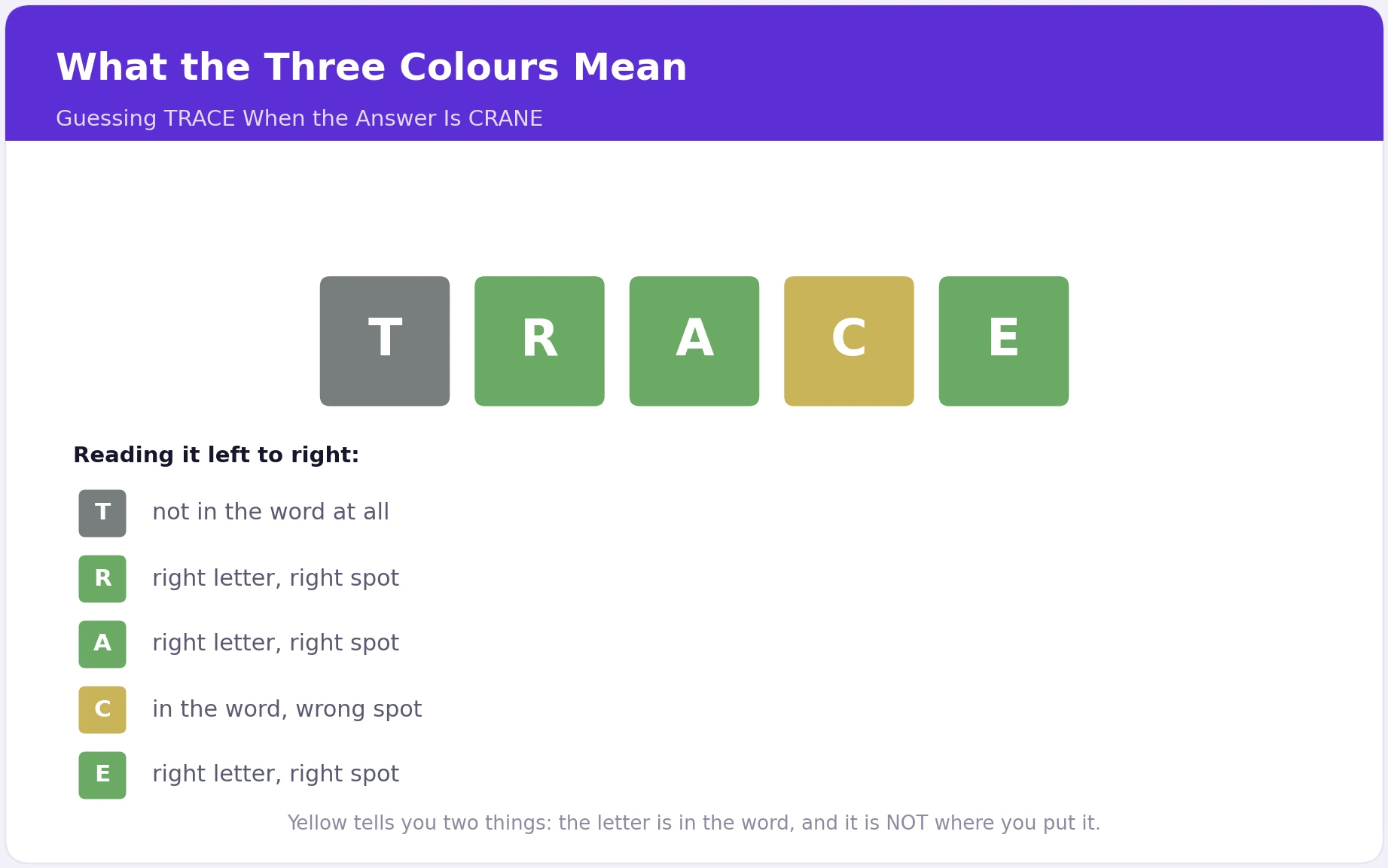
Reading these three colors is really all there is to how does wordle work. Master that, and the rest of the wordle rules are easy.
When you're stuck late in a round, a wordle word finder can take those same clues and show every word that still fits.
The Tricky Part: Duplicate Letters
Here's where almost every beginner gets stuck. Can a word repeat a letter? Yes. And the colors handle it in a way that looks broken at first.
About 15% of Wordle answers have a repeated letter. SWEET. ABBEY. LEVEL. RUPEE. So this comes up more than you'd think.
Say the answer is MATTE and you guess MATES. You'd expect both T positions to light up. They don't, because MATES only has one T. Simple enough.
Now flip it. The answer is ROBOT and you guess ROTOR. Your first R turns green. Your second R turns gray, even though ROBOT clearly has an R. Confusing, right?
The reason: Wordle colors greens first, then yellows, then leaves the rest gray. ROBOT has only one R, and your first R already claimed it. The extra one gets nothing.
So a gray tile doesn't always mean "not in the word". Sometimes it means "there's only one of these, and you already found it".
That's the one rule in wordle rules that catches people out. Once you know it, those weird gray tiles start telling you something useful about which 5 letter words still fit.
The Two Word Lists (Answers vs. Guesses)
Most players never learn this one. Wordle actually runs on two separate word lists.
The first is the answer list. It's small, around 2,300 words, and it's the only place a daily solution can come from. These are everyday words. No proper nouns, no abbreviations, and no plurals that just tack an S on the end.
The second is the guess list. Roughly 13,000 words you're allowed to type. Most of them will never be the answer. They exist so the game accepts your guesses.
So a rare word might be a perfectly valid guess and still be impossible as a solution. Handy to know when you're weighing 5 letter words for wordle late in a round.
Josh Wardle's partner helped trim that answer list down from about 10,000 words. Anything too obscure got cut, which is why wordle answers stay fair.
Want the full numbers on how many words sit in each list? Our guide on how many 5 letter words there are breaks it all down.
What Is Hard Mode?
Wordle has an optional setting called Hard Mode. You turn it on in the settings menu, and it changes how you're allowed to guess.
The rule is simple. Any green letter must stay in its spot in every guess after that. Any yellow letter must appear somewhere in your next guess too.
Normally you can ignore your clues for a turn. Say you know the word ends in ORE. You might guess a throwaway word packed with new consonants just to test them. Hard Mode blocks that.
So it takes away one of the best moves in the game. That's the point. It's meant for players who find normal wordle rules too easy.
Should you use it? Not at first. Learn how to play wordle properly with the standard settings. Once you're solving in three or four guesses most days, then try it.
One thing worth knowing: you can only switch it on before you start a puzzle, or after you finish one. Not mid-round.
A Quick Example Game
Let's play one round together. This shows how does wordle work in practice, guess by guess.
Today's answer is STORE. You don't know that yet.
Guess 1 — CRANE
The board comes back: C gray, R yellow, A gray, N gray, E green.
So the word ends in E. There's an R somewhere, just not in slot two. And C, A, N are all out.
Guess 2 — ROUSE
Good pick. It tests four fresh letters and keeps the R you already found.
Result: R yellow, O yellow, U gray, S yellow, E green.
Now you know a lot. The word has R, O, and S in it. None of them are where you put them. U is out. And E is still locked at the end.
Guess 3 — STORE
Look at what fits. You need S, T-ish filler, O, R, and E. R can't sit in slot one or two. O can't sit in slot two. S can't sit in slot four.
STORE fits every clue. Type it in.
All five tiles turn green. Solved in three.
That's the whole loop. Guess, read the colors, rule things out, guess again.
And when you're stuck halfway, a wordle solver does this narrowing for you. Feed in your greens, yellows, and grays, and it shows every one of the 5 letter words for wordle that still fit.
Where Did Wordle Come From?
The story behind Wordle is better than most people expect.
Josh Wardle, a software engineer, built a rough version back in 2013. He called it "Mr. Bugs' Wordy Nugz". Nobody played it. He shelved it.
Then in 2021 he picked it back up, this time as a gift for his partner Palak Shah. She loved word games, and he wanted to make one just for her.
Palak helped shape it too. The original word list had around 10,000 entries, packed with words nobody uses. She trimmed it down to only fair, everyday words.
It went live to a small group in June 2021, then opened to everyone that October. Ninety people played that month. By the end of December it was 300,000. By January, millions.
What made it explode? Players in New Zealand started posting their green and yellow grids on Twitter. No spoilers, just the pattern. That sharing habit spread worldwide.
The New York Times bought it on January 31, 2022 for a low seven-figure sum. The wordle rules stayed exactly the same after the sale.
Two odd facts. Every answer is already sitting in your browser when the page loads, the script just picks one by date. And the original answer list runs out around October 20, 2027.
In 2026, NBC announced a prime-time Wordle game show hosted by Savannah Guthrie. Not bad for a gift built for one person.
How to Start Playing (Best First Words)
Ready to play? Your opening word matters more than anything else you do.
A good opener tests common letters. E shows up in about half of all answers. A is close behind. Skip both, and you've ruled out roughly 69% of possible solutions in one guess.
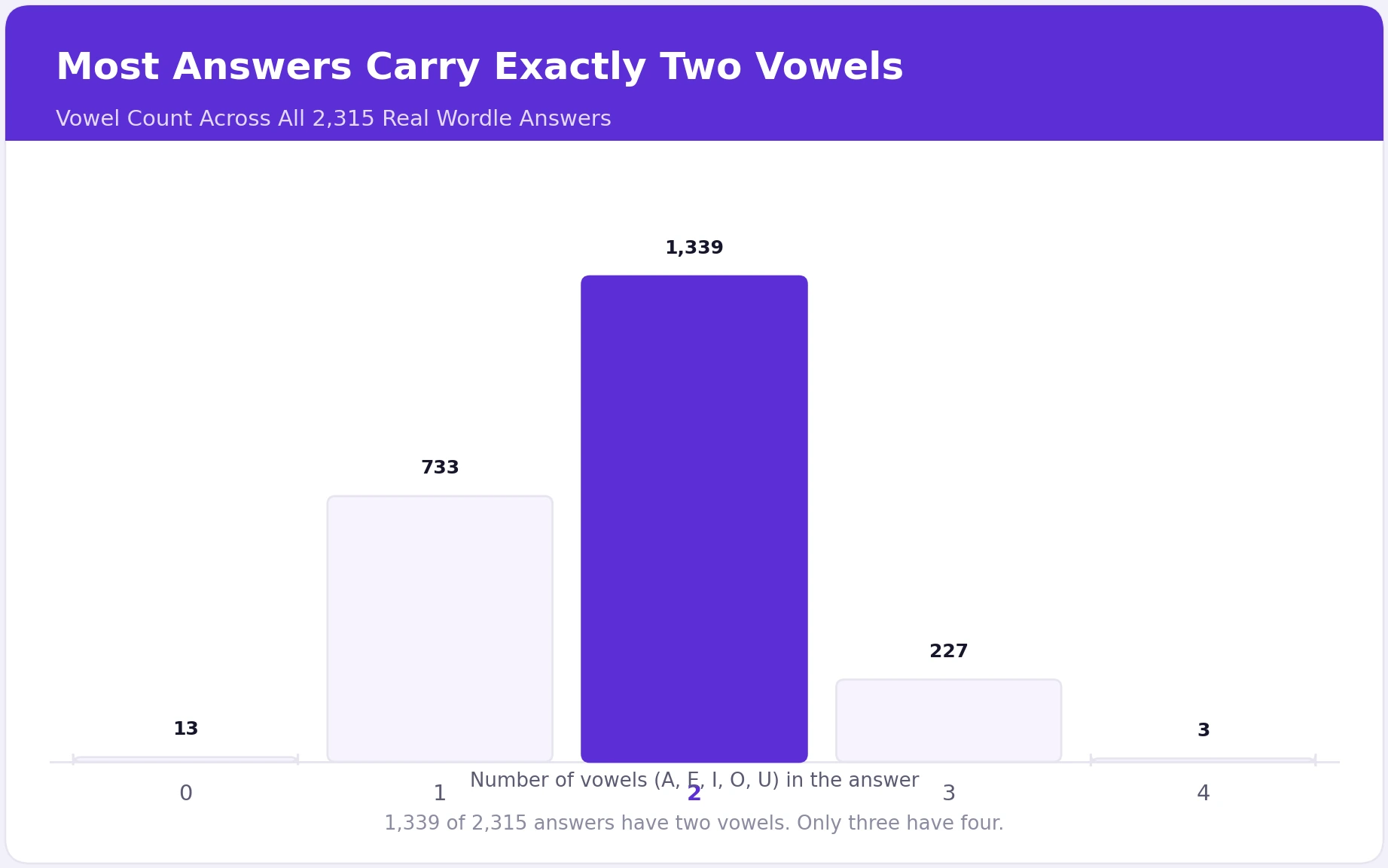
So pick a word packed with them. CRATE, CRANE, SLATE, RAISE, and STARE are all solid. Each one tests two vowels and three common consonants at once.
Pick one and stick with it. Rotating openers every day means you never learn the patterns. The best wordle starting words work because you get used to reading their results.
That's enough to start winning. If you want the deeper stuff, letter frequency by position, two-word openers, when to stop testing and start solving, our Wordle Strategy Guide covers all of it.
And on the days nothing fits, a wordle solver takes your clues and shows every one of the 5 letter words for wordle still standing.
Frequently Asked Questions
How many guesses do you get in Wordle?
Can you use the same letter twice in Wordle?
Can you play Wordle more than once a day?
Who created Wordle and who owns it now?
Is Wordle free to play?
Will Wordle ever run out of words?
Is Wordle good for your brain?
What is Wordle Bot?
Conclusion
That's how does wordle work, start to finish. Six guesses. One five-letter word. Three colors telling you what's right.
The wordle rules are simple enough to learn in two minutes. Green stays put, yellow moves, gray goes. Master those three, and you're already ahead of most casual players.
The tricky bits are worth remembering too. Letters can repeat. A gray tile sometimes means "only one of these". And the answer always comes from a small list of everyday words.
Want to get faster? Our Wordle Strategy Guide digs into openers, letter frequency by position, and when to stop testing and start solving.
And on the days nothing clicks, our 5 letter word finder takes your greens, yellows, and grays, and shows every word still standing.