Wordle Strategy Guide: From Beginner to Expert
Best openers, real letter-frequency data by position, when to pivot, and the advanced tactic most players never learn.
Winning at Wordle isn't really about knowing more words. It's about wordle strategy, reading feedback right, and knowing when a guess is smart versus just familiar.
This guide covers both ends, basic tips if you're new, and real letter-frequency data most wordle solver guides skip entirely if you already play daily. A few wordle tips here might change how you open every game.
Quick Intro
This guide works whether you just started playing or already solve most days. New players can build a solid wordle strategy from the basics up. Regular players can jump straight to the data.
And there is real data here. Further down, you'll find letter-frequency numbers pulled from actual Wordle answers, broken down by position, the kind of detail most wordle solver guides leave out completely.
Reading the Colors Correctly
Every guess gives you three colors, and reading them right is the whole game. Green means the letter is correct and in the right spot. Yellow means it's in the word, just somewhere else. Gray means it's not in the word at all.
That's the quick version. For a full breakdown, plus a hands-on wordle word finder that reads these colors for you, check the main tool page. This guide assumes you already know the basics and builds from there, so a good wordle finder can do the letter-matching while you focus on strategy.
Best Opening Words, Ranked
The best wordle starting words all do the same job: test as many common letters as possible in one guess. Here they are, ranked by how much ground each one covers.
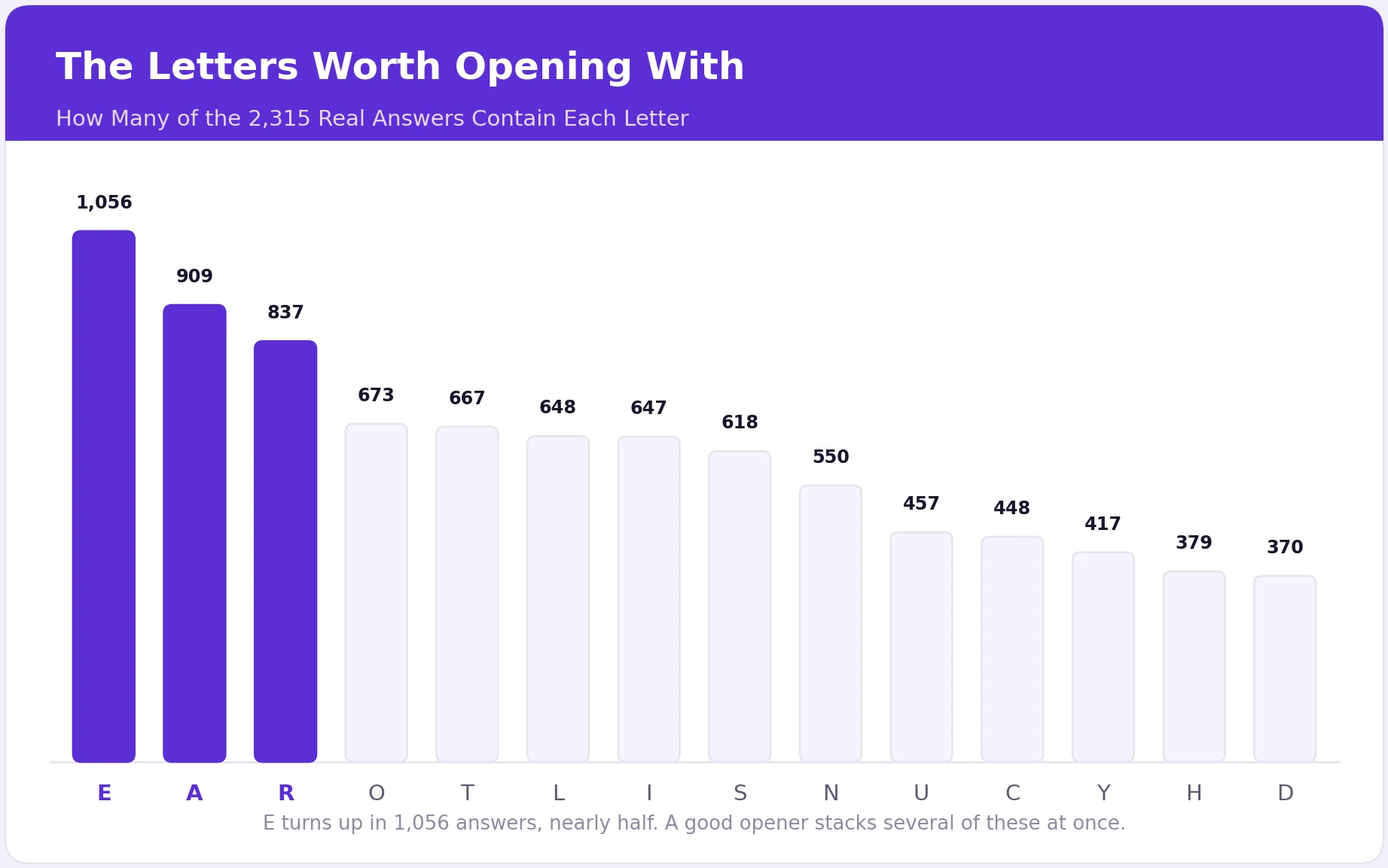
SLATE tops most lists. Two common vowels, three high-frequency consonants, nothing wasted.
CRANE is close behind, and the most popular opener overall. Strong vowel-consonant balance.
SALET is the mathematically best opener by some solver rankings, though it's an obscure word (a type of helmet). Great coverage, if you can remember it.
ADIEU takes the vowel route. Four vowels in one guess, ideal if you'd rather lock down vowels before consonants.
ROATE, STARE, and TRACE all sit in the next tier. Solid, balanced, and easier to remember than SALET.
RAISE is a favorite among 5 letter words for wordle because R, A, I, S, and E are all high-frequency.
SIREN rounds it out, useful if your usual opener keeps failing and you want a fresh letter mix.
There's no single winner. Pick one, stick with it, and let a wordle solver 5 letters at a time handle the narrowing after your first guess.
The 2-Word Opener Strategy
Here's a wordle strategy that trades one guess for a lot of certainty. Instead of one opener, use two fixed words every game, no matter what.
RAISE + DONUT is the classic pair. Between them, you test all five vowels plus R, S, N, and T, some of the most common consonants in the game. After two guesses, you've usually got a clear picture with zero luck involved.
Prefer a different mix? STALE + CORGI works too. It covers a similar spread but swaps in C and G, useful if you keep hitting words with those letters.
The trade-off is simple. You give up the chance to solve in one or two guesses. In return, your third guess almost always has enough information to close things out. For players who want steady results over a lucky streak, this wordle opener approach pays off more often than it costs.
Real Letter Frequency Data (By Position)
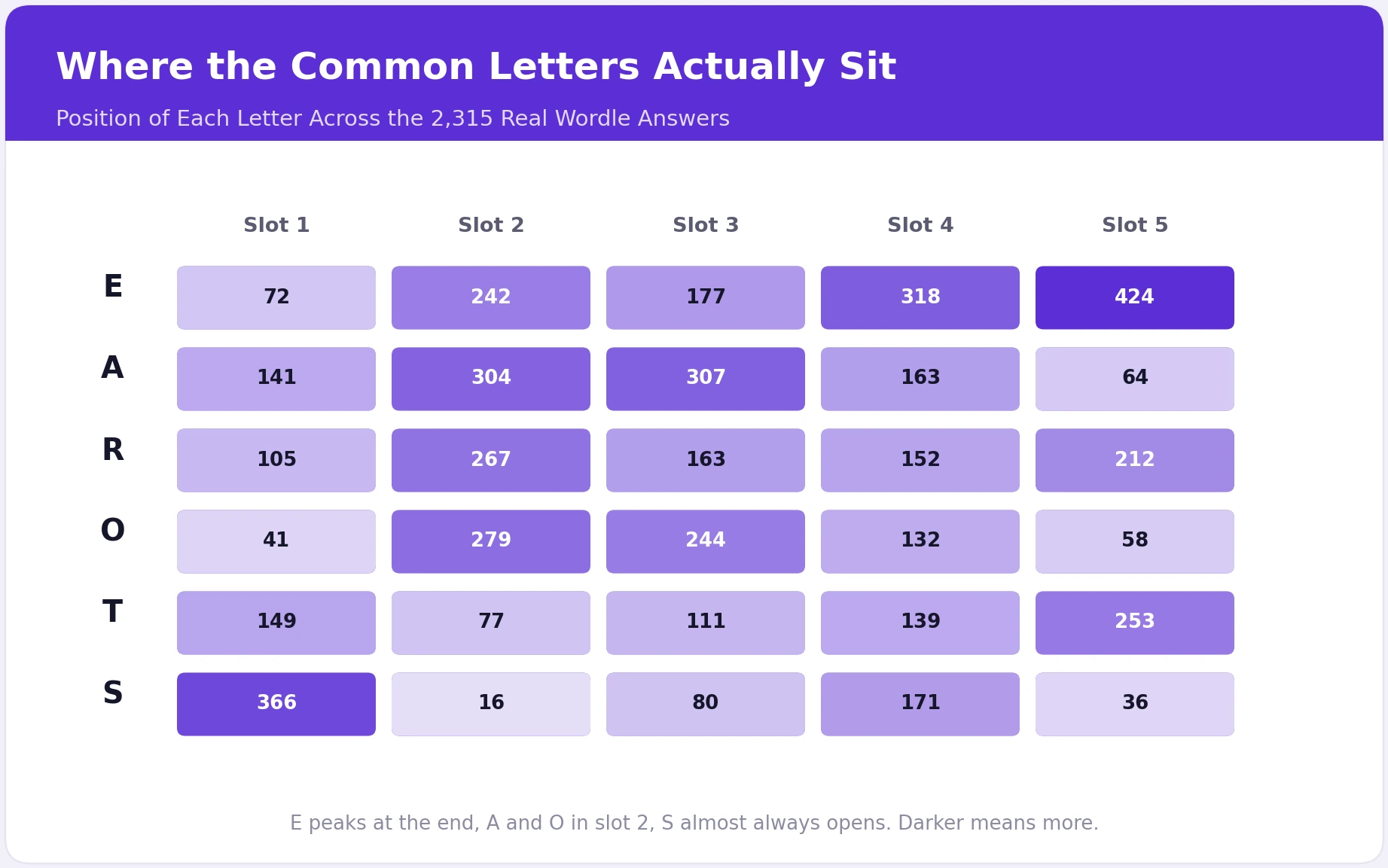
Most guides tell you which letters are common. Few tell you where they're common. Here's the real breakdown, based on all 2,315 actual Wordle answers, split by position.
Position 1 (First Letter)
S dominates the first slot, appearing in 366 answers, far ahead of the rest. C and B follow. If you're guessing a starting letter blind, S is the safest bet by a wide margin.
Position 2
The second letter is almost always a vowel. A leads with 304 answers, then O, then R. If your first letter is locked and the second is open, try a vowel here first.
Position 3
The middle slot leans vowel-heavy too. A tops it again with 307, followed by I and O. Consonants are rare in the exact center of a Wordle answer.
Position 4
E takes the fourth slot with 318 answers, then N and S. This position often sets up a common ending, so an E here is worth testing early.
Position 5 (Last Letter)
The final letter is the most predictable of all. E ends 424 answers, Y ends 364, and T ends 253. If you're stuck on the last letter, start with E or Y before anything else.
When to Pivot From Exploring to Solving
Your first two guesses have one job: test new letters. Your last few have a different job: actually solve. Knowing when to switch is where most games are won or lost.
Once you've got two or three green or yellow tiles, stop hunting for fresh letters. Shift into narrowing mode. This is exactly where a wordle solver earns its place, feeding it your known tiles cuts the list down fast.
Every 5 letter wordle answer still standing shares your confirmed clues. So your next guess shouldn't come from memory or habit. It should come straight from that shortlist. Guessing a random word at this stage wastes a turn you probably can't spare.
Advanced Tactic: The Best Guess Isn't Always a Possible Answer
Here's a wordle strategy most players never figure out. Sometimes the smartest wordle guess is a word that could never be the answer.
Wordle accepts close to 13,000 words as valid guesses. But only 2,315 of them are ever used as real answers. The other 10,000-plus exist purely to help you test letters.
Say you've narrowed it down to _OUND, and the options are BOUND, FOUND, HOUND, MOUND, POUND, ROUND, SOUND, WOUND. Guessing any one of them risks five wasted tries in a row. Instead, guess a word like BUMPH, it can't be the answer, but it tests B, M, P, and H all at once. One guess, and you likely know the real answer next turn.
A good wordle solver thinks this way by default. It's not looking for a lucky win, it's looking for the guess that removes the most options, even if that guess throws the round away on purpose.
Handling Duplicate Letters
Duplicate letters trip up more players than any other part of the game. Words like SPEED, ROBOT, and SKILL all repeat a letter, and it's easy to forget that's even allowed.
Here's the catch with the colors. If you guess a word with two E's but the answer has only one, one E shows up colored and the other turns gray. That gray doesn't mean E is absent, it just means there's only one. A lot of players misread this and rule out E completely.
When you're stuck and every single-letter guess has failed, doubles are usually the answer. It's a smart wordle strategy to test them once your obvious options run out. This is also where a wordle solver helps most, it tracks exact letter counts, so it won't wrongly drop a repeated letter the way a tired brain does.
Common Mistakes Beginners Make
Even players who know the rules lose guesses to the same handful of habits. Fix these, and your solve rate jumps fast. Here are the most common ones.
Repeating letters in your opener. A word like APPLE tests only four letters, not five. You're throwing away information before the game even warms up.
Putting a yellow letter back in the same spot. Yellow means the letter is in the word, just not there. Move it somewhere new next guess.
Reusing gray letters. Once a letter is ruled out, don't guess words that contain it. It's a wasted turn, especially mid-game.
Forgetting letters can repeat. SLEEP, ROBOT, SKILL all double up. If your single-letter guesses have failed, doubles are often the answer.
Ignoring the keyboard. The on-screen keyboard colors every letter you've tried. It's a free tracking tool, and most players never look at it.
Leaning too hard on vowel openers. ADIEU and AUDIO test four vowels, but skip strong consonants. A balanced wordle strategy usually beats a vowel-only one.
Guessing rare letters too early. Q, J, Z, and X almost never show up. Save them.
A smart set of wordle tips really comes down to this: use every clue, don't fight the feedback, and stay flexible when a puzzle turns nasty. Some of the hardest answers ever, PARER, MUMMY, ROWER, all end in -ER and trap players into guessing near-identical words in a row. The rules don't change, but the traps do.
Expert-Level Tips
Once the basics are second nature, these are the tricks that separate steady solvers from lucky ones.
Watch the endings. Certain word endings show up constantly, ING, EST, and ER lead the pack. Past-tense ED looks common but usually isn't, outside of a few verbs like CRIED, FRIED, and SPIED. Knowing this stops you from guessing endings that rarely appear.
Guess words with zero known letters on purpose. This feels wrong at first. If you already know three letters, why guess a word without any of them? Because a fresh word tests four or five brand-new letters at once, giving you far more information than shuffling ones you've already confirmed. It's the same logic that powers every top wordle strategy, maximize what you learn, not what you already know.
Keep your opener fixed. Even the best wordle starting words only work if you use them consistently. Rotating openers every day means you never learn their patterns. Pick one strong word, or one pair, and let it become muscle memory.
Full Worked Example: Start to Finish
Let's tie it all together with one complete solve. Watch how the opener, the pivot, and the elimination tactics work in one real game.
Guess 1 — CRANE. The board comes back: C gray, R gray, A gray, N gray, E green. So the word ends in E, and none of the other four letters belong. A rough start, but that's fine, you've ruled out four common letters already.
Guess 2 — SLIME. Now you're testing fresh letters, none of them repeats from guess 1. Result: S gray, L green, I gray, M gray, E green. Now you know it's _L__E, with L in spot two.
Guess 3 — GLOVE. Still exploring, still adding new letters. Result: G gray, L green, O green, V gray, E green. The picture is sharp now: _LO_E.
This is the pivot point. You've stopped hunting for letters and started solving. A 5 letter word finder for wordle would show only a few matches left: SLOPE, GLOBE, FLUKE... no, FLUKE doesn't fit. The real shortlist is short.
Guess 4 — SLOPE. S gray, so it's not SLOPE. But you've now confirmed the shape one more time.
Guess 5 — GLOBE. Every tile turns green. Solved.
Frequently Asked Questions
What is the best Wordle strategy for beginners?
What is the most effective way to start playing Wordle?
Is there a mathematically perfect Wordle opener?
What is the hardest Wordle word ever?
Is using a Wordle solver cheating?
How many possible Wordle answers are there?
Conclusion
Good Wordle isn't luck, it's habit. A solid wordle strategy comes down to a strong opener, careful reading of every color, and knowing when to stop exploring and start solving.
Start simple. Pick one opener, learn to read the tiles, and avoid the common traps. As you get comfortable, lean on the letter-frequency data and advanced tactics above to sharpen your solves.
And when a puzzle really has you stuck, that's what our word finder is for. Feed it your clues and it works like a wordle solver, showing only the 5 letter words for wordle that still fit. It won't play the game for you, but it'll keep your streak alive on the tough days.